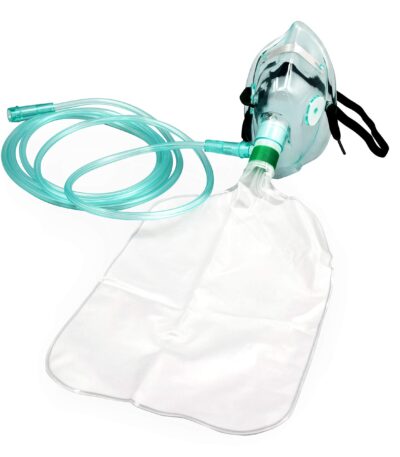
Non-Rebreather Mask (Paediatric)
-
Purpose & Use
-
A paediatric non-rebreather mask is used to deliver high concentrations of oxygen (60–100%) to children and infants experiencing severe hypoxia, respiratory distress, or trauma.
-
Designed to prevent exhaled air from mixing with supplied oxygen, ensuring maximum oxygen delivery to the patient.
-
-
Target Patient Population
-
Sized specifically for neonates, infants, and children.
-
Fits appropriately to cover the nose and mouth of smaller patients without excessive dead space.
-
-
Structure & Components
-
Mask: soft, flexible material to ensure comfort and minimal leakage.
-
Reservoir bag: smaller than adult versions, stores oxygen for inhalation.
-
One-way valves:
-
Between the mask and reservoir bag to allow inhalation of oxygen only.
-
On exhalation ports to prevent CO₂ rebreathing.
-
-
Elastic or Velcro straps: adjustable to secure mask on a child’s face.
-
Oxygen tubing connector: connects to an oxygen source.
-
-
Performance & Flow Rate
-
Provides high oxygen concentration (up to 100%) when properly fitted.
-
Oxygen flow typically 10–15 L/min for older children, and 5–10 L/min for infants depending on size.
-
One-way valves prevent rebreathing of CO₂.
-
-
Advantages
-
Rapidly increases oxygen saturation in paediatric patients.
-
Simple and effective high-flow oxygen delivery without intubation.
-
Disposable, reducing the risk of cross-contamination.
-
Lightweight and easy to apply to small patients.
-
-
Usage Guidelines
-
Ensure proper fit to minimize leaks.
-
Connect to appropriate high-flow oxygen source based on patient size.
-
Monitor oxygen saturation, respiratory rate, and comfort continuously.
-
Check that the reservoir bag remains partially inflated during inspiration.
-
Used as a short-term intervention until more definitive airway support is available if needed.
-
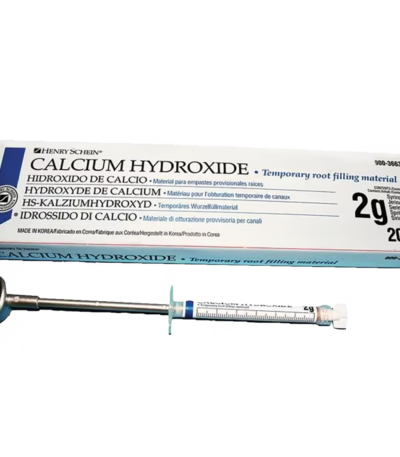
Non-Setting Calcium Hydroxide
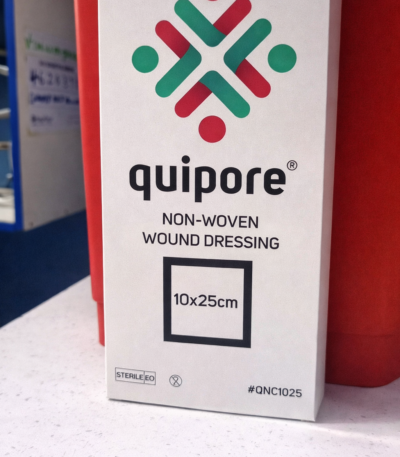
Non-Woven Wound Dressing (10cm by 25cm)
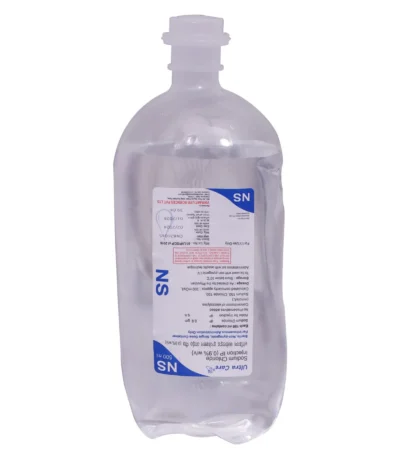
Normal Saline (NS)
Indications / Uses
Normal Saline is commonly used for:
-
Dehydration
-
Shock / hypovolemia
-
Fluid maintenance
-
Dilution of IV medications
-
Flushing IV lines
-
Blood transfusion compatibility
-
Diabetic ketoacidosis (initial fluid)
-
Sodium depletion (hyponatremia)
-
Replacing gastrointestinal fluid loss
Contraindications / Use with Caution
-
Heart failure (risk of fluid overload)
-
Kidney failure (risk of sodium and fluid retention)
-
Hypernatremia
-
Edema
-
Metabolic acidosis (Normal saline may worsen acidosis)

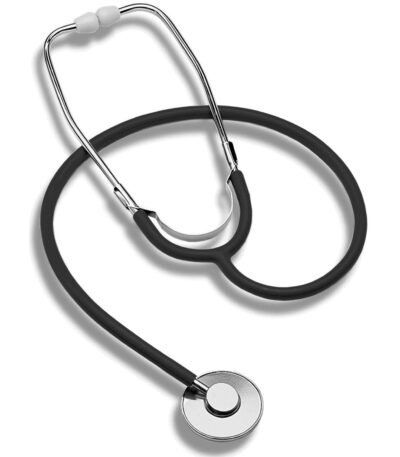
Nurse’s Stethoscope
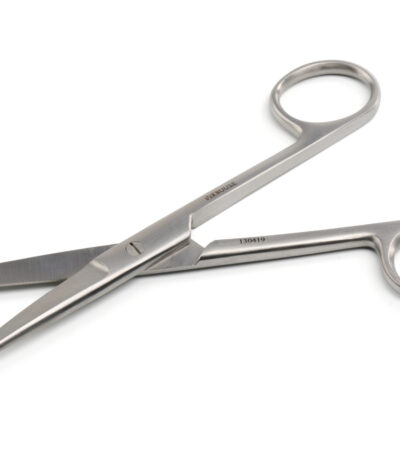
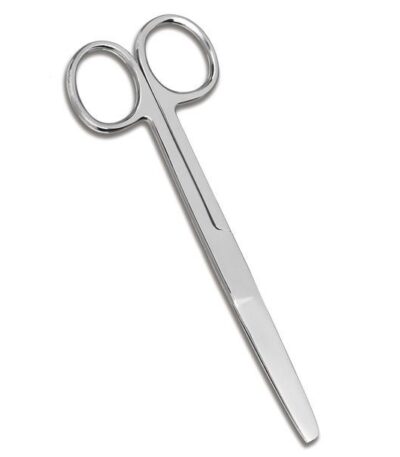
Nursing Scissors
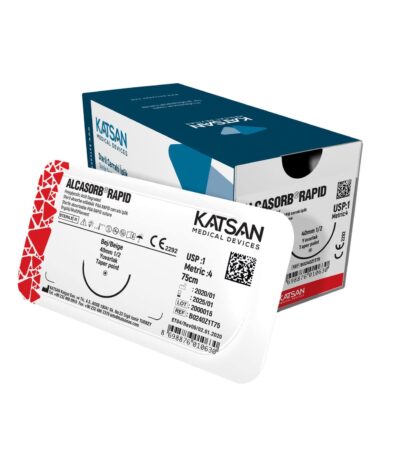
Nylon Suture (Dozen Pack – All Sizes)
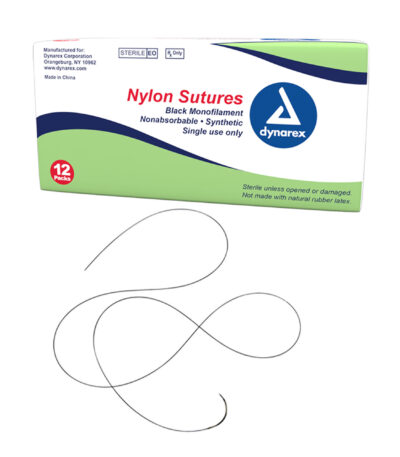
Nylon Sutures
-
Purpose & Use
-
Nylon sutures are synthetic, non-absorbable sutures used for closing skin, soft tissue, or surgical wounds.
-
Common in general surgery, plastic surgery, and minor procedures.
-
Often chosen for their high tensile strength and minimal tissue reaction.
-
-
Material & Properties
-
Made of nylon (polyamide), which is strong, smooth, and flexible.
-
Monofilament or braided forms:
-
Monofilament: single strand, less tissue drag, lower infection risk.
-
Braided: multiple fibers twisted together, stronger knot security but slightly higher infection risk.
-
-
Non-absorbable — stays in tissue until removed.
-
-
Sizes & Classification
-
Nylon sutures come in various sizes, typically ranging from 6-0 (very fine, used in delicate tissue like the face) to 5 or 4 (thicker, used in heavy tissue like fascia).
-
Size selection depends on tissue type, wound location, and desired cosmetic outcome.
-
-
Needles
-
Supplied pre-attached to surgical needles.
-
Needle types:
-
Curved needles (most common for internal tissues).
-
Straight needles (used in skin or minor procedures).
-
-
Needle shapes vary: reverse cutting, taper point, or cutting, depending on tissue type.
-
-
Packaging & Sterility
-
Usually individually sterile-packed, ready for use.
-
Available in single units or boxes containing multiple sutures of the same or mixed sizes.
-
-
Safety & Handling
-
Handle with sterile technique to avoid contamination or infection.
-
Non-absorbable — must be removed after wound healing (typically 5–14 days for skin, depending on location).
-

Olympus CX21 Microscope
Key Features
-
Optical System:
Uses the UIS2 (Universal Infinity System) optical design, which ensures bright, flat, and high-contrast images across the entire field of view. The optics are compatible with various objectives and accessories used in advanced Olympus systems. -
Objectives:
Typically equipped with Plan Achromat objectives (4×, 10×, 40×, and 100× oil immersion). These provide sharp and evenly illuminated images suitable for both brightfield observation and training. -
Eyepieces:
Standard 10× widefield eyepieces with a field number of 20 mm, allowing comfortable, wide viewing with minimal eye strain. -
Illumination:
Features a 6V 20W halogen lamp with adjustable brightness and built-in illumination control. Some models include a daylight filter to maintain consistent color balance. -
Condenser and Diaphragm:
Equipped with an Abbe condenser (NA 1.25) and an iris diaphragm for proper light control and contrast adjustment. -
Focusing Mechanism:
Coaxial coarse and fine focusing knobs with tension adjustment, allowing precise focusing control. The stage movement and focusing are smooth and ergonomic for extended use. -
Stage:
The mechanical stage is low-positioned for comfort, with X-Y coaxial controls. It typically measures around 130 mm × 160 mm and includes slide holders for accurate specimen movement. -
Frame and Build:
Compact, sturdy, and designed for long-term reliability. The microscope body is made from durable aluminum alloy to resist wear in high-use environments. -
Observation Head:
Binocular head inclined at 30° for comfort and fixed at a height ideal for seated use. The interpupillary distance and diopter can be adjusted to match different users. -
Portability:
Weighs approximately 6.5 kg, with a built-in carrying handle, making it easy to move between classrooms or laboratory stations.

Olympus CX23 Microscope
Key Features and Specifications
-
Optical System:
Infinity optical system that provides clear, bright, and high-contrast images across the entire field of view. -
Eyepieces:
Standard 10× widefield eyepieces with a field number of 20, providing a wide and comfortable viewing area. -
Observation Head:
Binocular viewing head inclined at 30°, with an interpupillary distance adjustable from 48 mm to 75 mm. The diopter adjustment allows easy focusing for individual users. -
Objectives:
Equipped with Plan Achromat objectives that are anti-fungal coated for longevity.-
4× (NA 0.10, working distance 27.8 mm)
-
10× (NA 0.25, working distance 8.0 mm)
-
40× (NA 0.65, working distance 0.6 mm)
-
100× oil immersion (NA 1.25, working distance 0.13 mm)
-
-
Stage:
A mechanical, rackless stage with X-Y coaxial controls for smooth slide movement. The travel range is approximately 76 mm (X) × 30 mm (Y). Its rackless design increases safety and prevents snagging during use. -
Condenser:
Abbe condenser (NA 1.25) with an adjustable iris diaphragm for proper light control and optimal image contrast. -
Illumination:
Built-in long-life LED illumination that provides bright, uniform lighting with daylight color balance. It consumes very little power and requires minimal maintenance, ideal for continuous use in classrooms and labs. -
Focusing Mechanism:
Coaxial coarse and fine focus knobs on both sides of the microscope. The coarse focus travel distance is about 15 mm, and the fine adjustment allows for precise focusing down to 2.5 micrometers. -
Body and Build:
The frame is made from die-cast aluminum, ensuring rigidity and long-term durability. The optical components are treated with anti-fungal coatings, making the CX23 suitable for use in humid or tropical environments. -
Ergonomic Design:
Compact, lightweight, and easy to handle. Includes a built-in carrying handle, a power cord storage compartment, and an anti-theft slot for secure use in shared environments. -
Weight:
Approximately 5.9 kilograms, making it portable and easy to move between classrooms or laboratories.