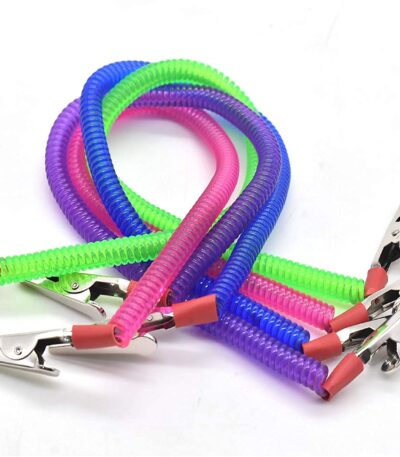
Bib Holder (Dental Bib Clip / Chain Holder)
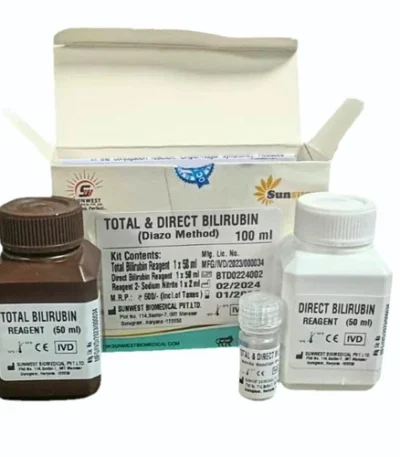
Bilirubin – Total & Direct
🔬 1. Direct Bilirubin (Conjugated) — Diazo Method
Principle
Direct (conjugated) bilirubin reacts directly with diazotized sulfanilic acid to form azobilirubin, a reddish-purple complex.
-
Absorbance: ~540–560 nm
-
Method: Endpoint or timed endpoint
-
No accelerator needed (only conjugated bilirubin reacts)
Reagent Components
-
Sulfanilic acid
-
Sodium nitrite
-
Hydrochloric acid (for diazo formation)
-
Buffer (acetate)
-
Preservatives
Some manufacturers supply:
-
R1: Buffer
-
R2: Diazo reagent
🧪 2. Total Bilirubin — Diazo Method (Accelerated)
Principle
Unconjugated bilirubin requires an accelerator to react with the diazo reagent.
Common accelerators:
-
Caffeine–benzoate
-
Surfactants
-
Methanol or DMSO (older methods)
Total bilirubin reacts with diazo reagent to form azobilirubin.
-
Absorbance: ~540–560 nm
-
Method: Endpoint or timed endpoint
Reagent Components
-
Caffeine-benzoate accelerator
-
Sulfanilic acid
-
Sodium nitrite
-
Acid buffer
-
Stabilizers and preservatives
Formats:
-
1-reagent systems (common today)
-
2-reagent systems (R1 accelerator + R2 diazo reagent)
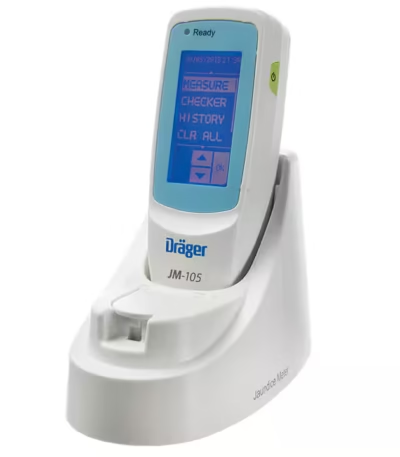
Bilirubinometer
A bilirubinometer is a medical diagnostic device used to measure the level of bilirubin in newborns (and sometimes adults) to identify and monitor jaundice
There are two main types:
-
Transcutaneous bilirubinometers: Non-invasive devices that estimate serum bilirubin by shining light onto the baby’s skin (often the forehead, sternum, or ear).
-
Serum bilirubinometers: Use a small blood sample and laboratory optics or photometry to give a direct bilirubin reading.
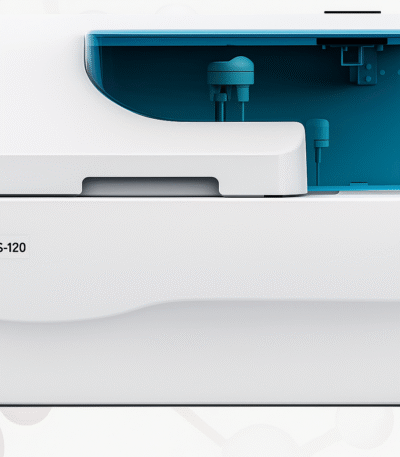
BIOELAB AS‑120 Fully Automatic Clinical Chemistry Analyzer / AS‑120 Auto Biochemistry Analyzer
Key Features & Specifications
-
Type: Fully automatic, random-access chemistry analyzer with open reagent system (can use reagents from different suppliers).
-
Throughput: Approximately 120 tests per hour.
-
Reagent capacity: Typically around 80 positions (40 for R1 + 40 for R2) with ~40 sample positions.
-
Reaction cuvettes: Around 50 cuvettes; reaction volume ~150 µL to ~330 µL.
-
Optical system: Multi-wavelength detection (340 nm, 405 nm, 450 nm, 505/510 nm, 546 nm, 578 nm, 630 nm, 700 nm).
-
Reagent tray cooling: Continuous cooling system maintaining 2 °C–14 °C.
-
Sample & reagent probe features: Liquid level detection, collision protection, automatic probe cleaning and adjustment.
-
Calibration & quality control: Supports linear and nonlinear calibration, multi-point calibration, Westgard QC plotting.
-
Physical footprint: Approximately 750 mm × 550 mm × 490 mm; weight ~70 kg.
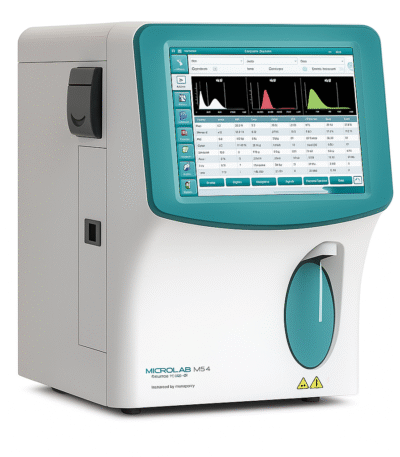
BIOELAB-3-Part Hematology Analyzer EC-30
✅ Key Features & Specifications
Here are the primary specifications and features of the EC‑30:
-
The throughput is up to 60 samples/hour in whole blood mode. labtex.cn+3en.bioelab.net+3Alibaba+3
-
It supports a 3‑part WBC differential (i.e., neutrophils, lymphocytes + mid cell group, granulocytes) — which is standard for “3‑part” hematology analyzers. Wikipedia+2en.bioelab.net+2
-
Minimum sample volume: about 9 µL of whole blood. en.bioelab.net+1
-
Built‑in 10.4‑inch colour touch screen display. Alibaba+1
-
Data storage: capable of storing large number of results (for example, up to ~500,000 results in some specs) including histograms. Scribd+2en.bioelab.net+2
-
Compact design, around < 28 kg in some spec sheets; built‑in thermal printer in some versions. en.bioelab.net+1
-
Reagent requirements: typically a diluent plus a lysing reagent for the 3‑part differential mode. en.bioelab.net+1
-
Interface: USB, LAN ports etc for connectivity. en.bioelab.net
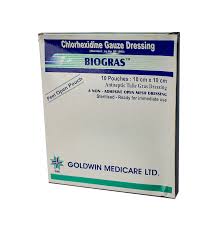
Biograss 10x10cm (10s)
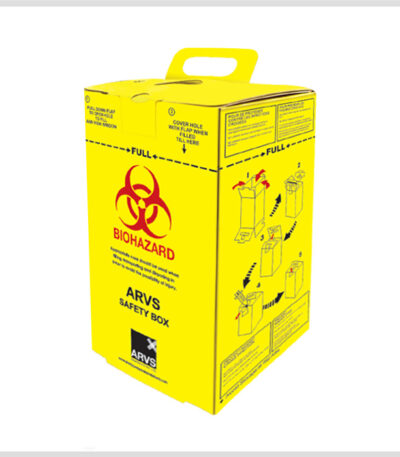
Biohazard Safety Boxes (5 Litres)
A Biohazard Safety Box (5 litres) is a sturdy, specially designed container used for safely collecting and disposing of sharps such as needles, syringes, scalpels, and other medical items that can cause injury or contamination.
It is made from durable, puncture-resistant material and clearly marked with biohazard warning symbols so that everyone can easily recognize that it contains dangerous medical waste. The 5-litre size is convenient for clinics, laboratories, hospitals, and outreach programs because it holds a good amount of waste without being too bulky.
Once the box is full, it can be securely sealed to prevent accidental exposure or spillage, ensuring the safety of healthcare workers, patients, cleaners, and waste handlers. It helps maintain hygiene, prevents needle-stick injuries, and reduces the spread of infections during medical waste disposal.
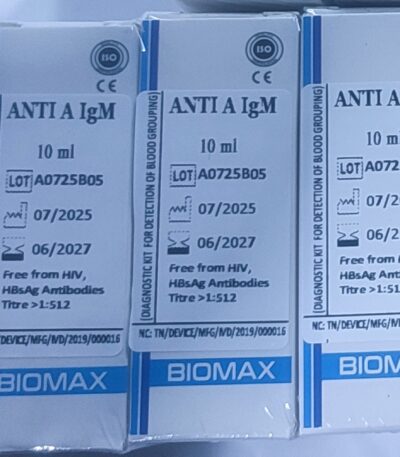
Biomax Antisera Anti A- – 10 ml
Key Features
-
Accurate Blood Grouping: Specifically formulated to detect A antigens with clear, visible agglutination reactions.
-
Consistent Performance: Manufactured under strict quality standards to ensure reliable and repeatable results.
-
Ready-to-Use: Supplied in a 10 ml dropper bottle for convenient dispensing during routine testing.
-
Clear & Fast Reactions: Delivers crisp agglutination that is easy to interpret, reducing chances of error.
-
Stable & Long-Lasting: Designed to maintain effectiveness within recommended storage conditions.
Applications
-
ABO blood grouping
-
Blood bank screening
-
Transfusion compatibility testing
-
Routine lab diagnostics
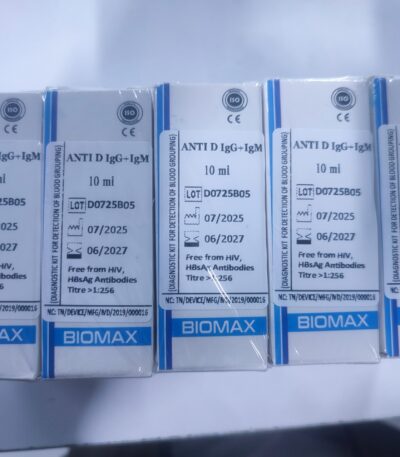
Biomax Antisera Anti-D – 10 ml
Key Features
-
Accurate Rh (D) Detection: Formulated to deliver clear, dependable agglutination results when testing for the D antigen.
-
Ready-to-Use Liquid Reagent: No further dilution required—convenient for routine use and emergency blood typing.
-
10 ml Volume: Ideal for moderate to high sample workloads while minimizing wastage.
-
High Sensitivity & Specificity: Engineered to reduce false reactions and ensure consistent, trustworthy outcomes.
-
Quality-Assured Manufacturing: Produced under stringent standards to maintain stability, clarity, and performance.
-
Compatible With Standard Testing Methods: Suitable for slide, tube, and immediate spin techniques, depending on lab protocol.